What’s the Difference Between Lambada and Brazilian Zouk?
Written by Larissa Ferreira
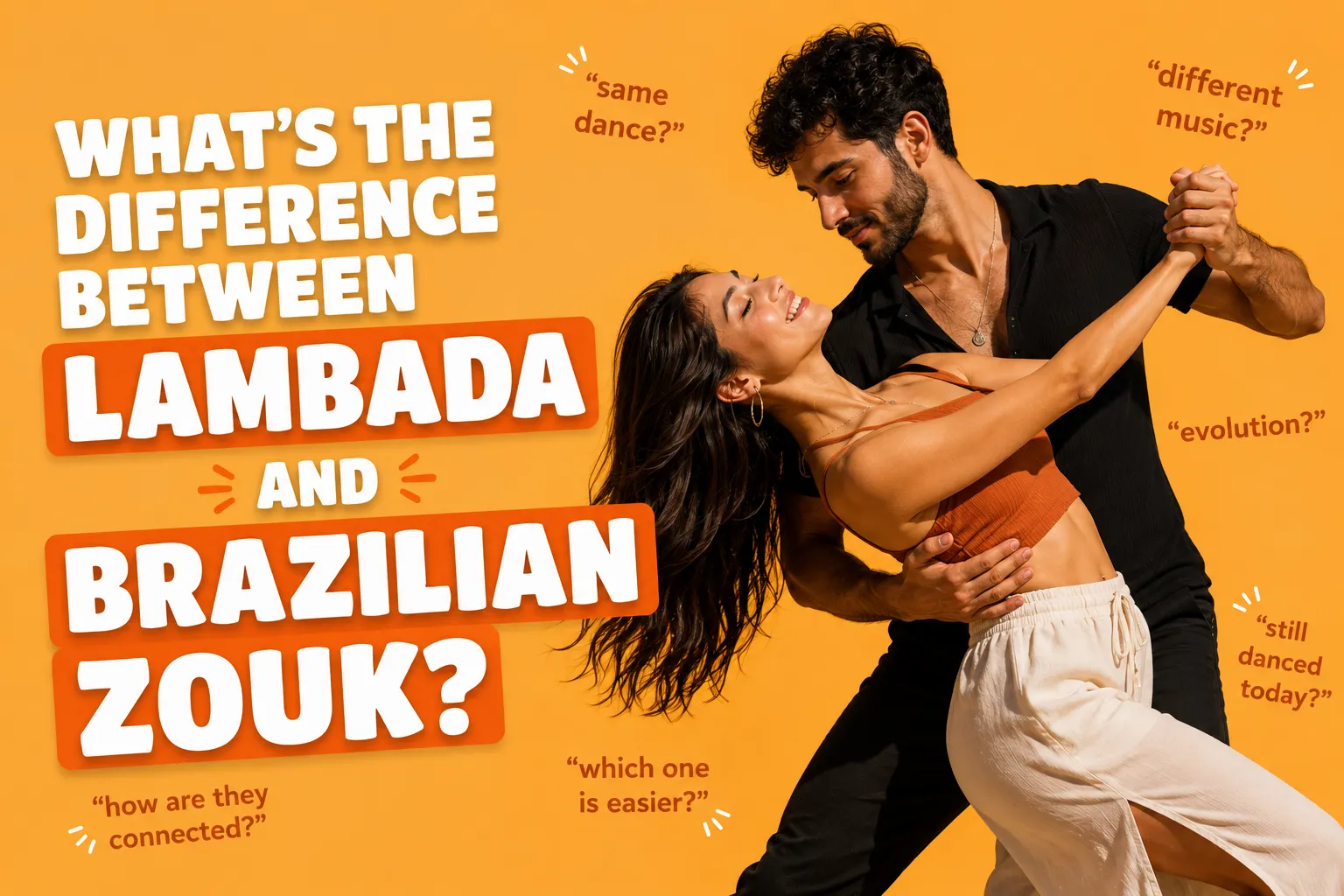
If you’ve heard that Brazilian Zouk evolved from Lambada, it’s natural to assume they’re essentially the same dance with different names.
But that’s not quite the case.
Brazilian Zouk evolved from Lambada in the early 1990s and still carries elements of those roots. Over time, however, new music, techniques, and influences contributed to the development of its own distinct characteristics.
Today, Lambada and Brazilian Zouk are distinct dances, although the connection between them remains strong.
To understand the differences, we need to go back a little.
Are Lambada and Brazilian Zouk the Same Dance?
No.
Brazilian Zouk evolved from Lambada in the early 1990s. Throughout this process, movements from Lambada were adapted to different styles of music and influenced by other dances, contributing to the development of a dance with its own characteristics.
This explains why someone seeing both dances for the first time might notice so many similarities.
They share a common heritage, but that doesn’t mean Brazilian Zouk is simply another name for Lambada.
How are Lambada and Brazilian Zouk connected?
The story begins long before the name Brazilian Zouk existed.
Lambada developed in Brazil through different cultural exchanges. The study Tensions of the Historiographic Traces of Brazilian Zouk, published in the Revista Brasileira de Estudos da Presença, points to influences from Latin American and Caribbean genres circulating in Pará, as well as Brazilian genres such as Carimbó, Guitarrada, and Maxixe.
In the 1980s, Lambada became increasingly popular as both a dance and a musical genre and later gained international recognition. One of the major milestones of this period was the release of “Chorando Se Foi” by Kaoma in 1989, which helped introduce Lambada to audiences around the world.
According to the Brazilian Zouk Dance Council (BZDC), as Lambada's commercial popularity declined, dancers began experimenting with other music, particularly Zouk music from the French Antilles. The slower tempo also contributed to changes in the way Lambada movements were performed and to the development of new techniques.
This is where an important distinction comes in: Zouk music, Zouk dance and Brazilian Zouk are not the same thing.
Zouk already existed as a Caribbean musical genre and dance, particularly associated with the French Antilles. Brazilian Zouk, on the other hand, is the Brazilian partner dance that evolved from Lambada.
During this transition, the terminology surrounding the dance also changed. Different names were used before Brazilian Zouk became established as a way to distinguish the Brazilian dance from Caribbean Zouk.
The change in name was also connected to Lambada’s image at the time. As the dance became internationally popular, it became strongly associated with sensuality and was often portrayed as a highly sexualized dance.
Some dancers and teachers wanted to distance the evolving dance from that reputation, which also contributed to the transition from the name Lambada to Zouk and, eventually, Brazilian Zouk.
The history behind why the name changed, who shaped Brazilian Zouk, and how the dance developed during this period is more complex. If you want to explore that story in more detail, read our article about the origins and history of Brazilian Zouk.
So, what changed?
This is where the differences become easier to notice on the dance floor.
Music
This is perhaps one of the most important distinctions.
Lambada developed in connection with faster music and a strong rhythmic emphasis. During the development of Brazilian Zouk, dancers began experimenting with slower music, initially associated with Caribbean Zouk.
This change also influenced how movements were performed and developed.
Over time, Brazilian Zouk expanded its relationship with different musical genres even further. Anyone who attends Brazilian Zouk events today knows that a single night can include a wide variety of music.
In other words, the difference isn’t only about what the dancers do, but also about how they respond to the music.
Movement and dynamics
Lambada is historically associated with a faster dynamic, with a strong emphasis on lower-body movement, hip movements, turns, and traveling steps.
Throughout its own development, Lambada also incorporated cambrés and movements involving the torso and head.
This is an important detail, since these elements are often associated exclusively with Brazilian Zouk.
As Brazilian Zouk evolved and dancers began exploring different music, new possibilities emerged. Slower music allowed dancers to develop different approaches to traveling, connection, musical interpretation, and body movement.
That’s why simply saying “Brazilian Zouk is a slower version of Lambada” doesn’t tell the whole story. The change in musicality was important, but the dance continued to develop and incorporate new influences.
Structure and use of space
Another transformation involved how the dance was organized and moved through space.
According to historiographical research, in Rio de Janeiro, for example, teachers began exploring more linear movements, in contrast with the more circular characteristics associated with Lambada.
Influences from other Brazilian and Latin dances also contributed to this development.
These transformations help explain why two historically connected dances can look so different today.
Why do they still look so similar?
Because they share a real heritage.
Head and torso movements, turns, cambrés, hip movements, and different forms of connection didn’t suddenly appear with Brazilian Zouk.
Part of this movement vocabulary was already present throughout Lambada’s development and continued to be transformed by later generations.
For those who are just getting started, the similarities may be more noticeable than the differences.
For more experienced dancers, differences in musicality, timing, dynamics, and use of space tend to become easier to recognize.
Does dancing Brazilian Zouk mean you can automatically dance Lambada?
Not necessarily.
Familiarity with connection, body movement, and some shared principles can certainly help, but knowing one dance doesn’t automatically mean you’ve mastered the other.
For someone accustomed to Brazilian Zouk, for example, adapting to Lambada’s speed, rhythm, and dynamics may require specific practice.
And the opposite is also true.
Perhaps the best way to truly understand the differences is simply to experience both.
Is Lambada still danced today?
Yes, and this is an important point. In fact, Lambada has been gaining popularity again in recent years, with more dancers returning to the dance and a growing presence in classes, socials, and events.
Telling the story as “Lambada existed, lost popularity, and became Brazilian Zouk” can create the misleading impression that one dance simply replaced the other.
That’s not what happened.
Brazilian Zouk evolved from Lambada and continued developing its own characteristics, while Lambada itself continued to be practiced and developed.
Today, Lambada is taught and danced internationally, with dedicated festivals and events taking place in different countries.
The terminology has also evolved. In some communities, the term LambaZouk was used for styles closely connected to Lambada, while today the name Lambada is increasingly used again.
So rather than seeing Lambada only as part of Brazilian Zouk’s past, it makes more sense to see Lambada and Brazilian Zouk as two living dances with a shared history.
Lambada and Brazilian Zouk: connected, but not the same
Perhaps this is the simplest way to answer the original question:
Brazilian Zouk evolved from Lambada, but today they are distinct dances.
From those roots, changes in musicality, along with the influence of different teachers, communities, and dance styles, helped Brazilian Zouk develop its own characteristics.
Understanding this history isn’t just about knowing where Brazilian Zouk came from. It also helps explain why so many elements of Lambada are still present in the dance and why the two remain so closely connected.
If you want to experience these differences beyond theory, Duo helps you discover Lambada and Brazilian Zouk classes, socials, workshops and events around the world.


Frequently asked questions
Is Brazilian Zouk the same as Lambada?
No. Brazilian Zouk evolved from Lambada in the early 1990s, but over time it developed its own characteristics, musicality, and movement vocabulary. Today, they are considered distinct but closely connected dances.
Did Brazilian Zouk come from Lambada?
Yes. Brazilian Zouk evolved from Lambada in Brazil in the early 1990s. As dancers began adapting Lambada movements to Caribbean Zouk music and other musical styles, the dance gradually developed new characteristics.
Despite the name, Brazilian Zouk should not be confused with Caribbean Zouk music or dance.
Is Lambada still danced today?
Yes. Lambada did not disappear when Brazilian Zouk emerged. It continues to be practiced and taught around the world, with its own dancers, teachers, and events.
Can Brazilian Zouk dancers dance Lambada?
Not automatically. The two dances share some movement principles and historical roots, which may make learning easier, but Lambada has its own rhythm, dynamics, and characteristics that require specific practice.
What is the main difference between Lambada and Brazilian Zouk?
There isn't just one difference. Music, timing, dynamics, movement, and use of space all help distinguish the two. Brazilian Zouk evolved from Lambada but continued developing through new musical and technical influences.