Do Advanced Dancers Have a Responsibility to Dance With Beginners?
Written by Larissa Ferreira
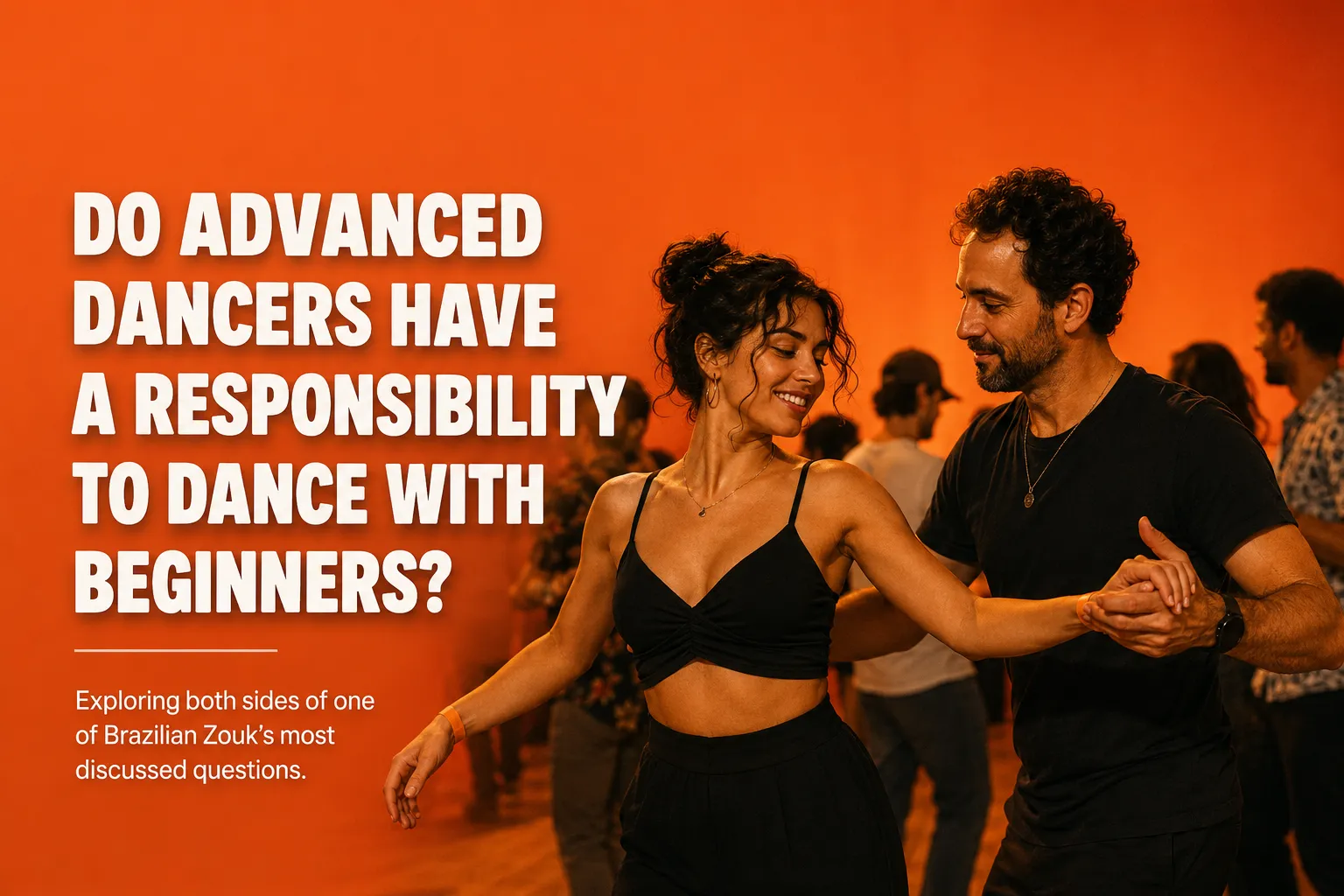
You’ve taken a few Brazilian Zouk classes.
You finally decide to go to a social.
You look around the room and see dancers you admire — people with years of experience, beautiful connection and movements that seem effortless.
And then comes the intimidating part:
asking one of them to dance.
For many beginners, entering the social dance community can feel like entering a room where everyone already knows each other — and everyone seems much better than you.
If you're still taking your first steps in the dance, our guide Brazilian Zouk for Beginners: Where to Start can help you navigate the beginning of your journey.
This raises a surprisingly divisive question:
Do advanced dancers have a responsibility to dance with beginners?
Some dancers argue that experienced members of a community can play an important role in making newcomers feel welcome.
Others point out something equally important:
Nobody owes anyone a dance.
So where does community responsibility end and personal choice begin?
Why dancing with advanced dancers can matter so much to beginners
Your first socials can be intimidating.
You’re still thinking about your basics. You might worry about forgetting a movement, missing the timing or boring your partner.
That uncertainty appears frequently in online Brazilian Zouk communities.
Beginners ask whether they are ready to attend socials at all. Others worry that knowing only basic movements won't be enough to give their partners an enjoyable dance.
And the jump from classes to the wider community can feel even bigger.
A 2025 episode of the ZoukNerds podcast was dedicated entirely to making Brazilian Zouk more accessible to beginners, discussing barriers newcomers encounter and ways communities can become more welcoming.
That's why a dance with someone experienced can mean more to a beginner than simply getting through another song.
It can make them feel like they belong in the room.
But does that make it an advanced dancer's responsibility?
This is where things become complicated.
Being advanced doesn't turn someone into a teacher every time they enter a social.
Experienced dancers may want to dance with close friends, explore more complex ideas with compatible partners or simply choose whoever they feel like dancing with that night.
And regardless of someone's level:
everyone should be allowed to say no to a dance.
Creating a welcoming community cannot depend on removing someone's ability to choose their own partners.
So perhaps the question isn't whether advanced dancers owe beginners dances.
Maybe it's whether experienced dancers have some influence over the kind of community beginners encounter.
Those are not quite the same thing.
“Nobody owes anyone a dance” and “community matters” can both be true
These ideas can sound contradictory:
You don't owe anyone a dance.
The way you treat beginners affects your community.
But both can exist at the same time.
Nobody needs to accept every invitation.
At the same time, social dance communities aren't built only through classes, technique and events. They're also shaped through hundreds of small interactions:
a smile, an invitation, an introduction, a conversation, or one enjoyable dance with someone who clearly has much more experience.
Individual choices can collectively create a culture.
And that culture influences whether a beginner thinks:
“I want to come back next week.”
Or:
“Maybe this community isn't for me.”
Are beginners actually boring to dance with?
This fear comes up surprisingly often.
Beginners sometimes assume that because their movement vocabulary is limited, an advanced dancer couldn't possibly enjoy dancing with them.
That insecurity can become even stronger when most of the Zouk we see online features experienced dancers, impressive movements and carefully selected moments.
We explored this perception in Why Does Everyone Seem to Dance Better on Social Media?
But complexity isn't the only thing that can make a dance enjoyable.
A recent discussion in the Brazilian Zouk community raised an interesting question: does becoming more advanced mean moving away from the basics?
The dancer who started the discussion questioned this idea, describing the basics instead as an opportunity to connect, reconnect and gradually build a dance.
It doesn't tell us how every advanced dancer feels about dancing with beginners. But it does challenge an assumption many beginners carry:
more movements don't automatically mean a better dance.
And someone doesn't necessarily need an advanced vocabulary to create an enjoyable connection.
The experience can be different at a local social and at a festival
Context matters too.
A small weekly social and an international festival don't necessarily create the same expectations.
At a local social, dancers see each other regularly. Today's beginner may become an active member of that community months later.
There can be a stronger sense of building something together.
Festivals are different.
People may have traveled internationally, spent significant money and waited months to dance with particular friends or dancers.
The question of which events feel more comfortable for less experienced dancers also comes up in the community. A recent discussion on Reddit about beginner-friendly festivals and intensives shows that the size and format of an event are also part of this conversation.
So expecting exactly the same social dynamics everywhere may not be realistic.
What experienced dancers can offer, without owing anyone a dance
Maybe responsibility is the wrong word.
An advanced dancer doesn't need to dance with every beginner to contribute to a welcoming environment.
Sometimes inclusion looks much smaller.
Acknowledging someone you've seen in class.
Introducing a newcomer to other dancers.
Starting a conversation.
Accepting a dance when you genuinely want to.
Or even asking a beginner yourself.
These interactions don't require anyone to sacrifice their boundaries.
But they can make a room that initially feels intimidating feel much easier to enter.
And some Brazilian Zouk communities explicitly make this part of their identity, describing their spaces as welcoming to complete beginners while creating opportunities for dancers of different levels to train and socialize together.
Maybe the responsibility belongs to the community, not the individual
This might be the more useful way to frame the debate.
Instead of asking:
“Which advanced dancers aren't dancing with enough beginners?”
we could ask:
“What makes beginners feel welcome enough to stay?”
Teachers can prepare students for their first social.
Organizers can create environments where different levels interact.
Regular dancers can introduce newcomers to each other.
Experienced dancers can choose to participate in that culture without being individually responsible for everyone's experience.
And beginners can gradually become the dancers welcoming the next generation.
Because today's advanced dancers were beginners once too.
So, should advanced dancers dance with beginners?
There probably isn't a universal rule.
Advanced dancers don't owe beginners a dance simply because they have more experience.
At the same time, experience often comes with something beginners don't have yet:
the ability to make the room feel less intimidating.
Choosing to share a dance, a conversation or even a simple welcome can have an impact far beyond one song.
Maybe that's the distinction that matters.
You don't have to dance with everyone to help create a community where everyone feels they can dance.
And perhaps the most interesting question isn't whether advanced dancers have a responsibility to beginners.
It's:
What kind of dance community do we want beginners to enter?
Find your next dance community with Duo
Every dance community has its own rhythm, both on and off the dance floor.
With Duo, you can discover classes, socials, workshops and festivals around the world, from Brazilian Zouk and Lambada to Kizomba, Bachata, Salsa, West Coast Swing, Forró, Tango, Samba de Gafieira and more.
Whether you're attending your first social or planning your next festival, Duo helps you find places to dance and communities to connect with.
Download Duo and discover your next dance.


Frequently asked questions
Do advanced dancers have to dance with beginners?
No. Everyone has the right to choose who they dance with. However, experienced dancers can influence how welcoming a community feels to newcomers.
Is it okay for a beginner to ask an advanced dancer to dance?
Yes. Being at a different level doesn't make an invitation inappropriate. The other person is also free to accept or decline.
Can advanced dancers enjoy dancing with beginners?
Yes. An enjoyable social dance isn't necessarily defined by complex movements. Connection, comfort, musicality and solid fundamentals can all shape the experience.
When should beginners start going to Zouk socials?
There's no universal milestone. Some beginners attend socials very early, and community discussions often encourage newcomers to participate even while they're still learning the fundamentals.