What Does “Zouk” Mean? The Story Behind the Name
Written by Larissa Ferreira
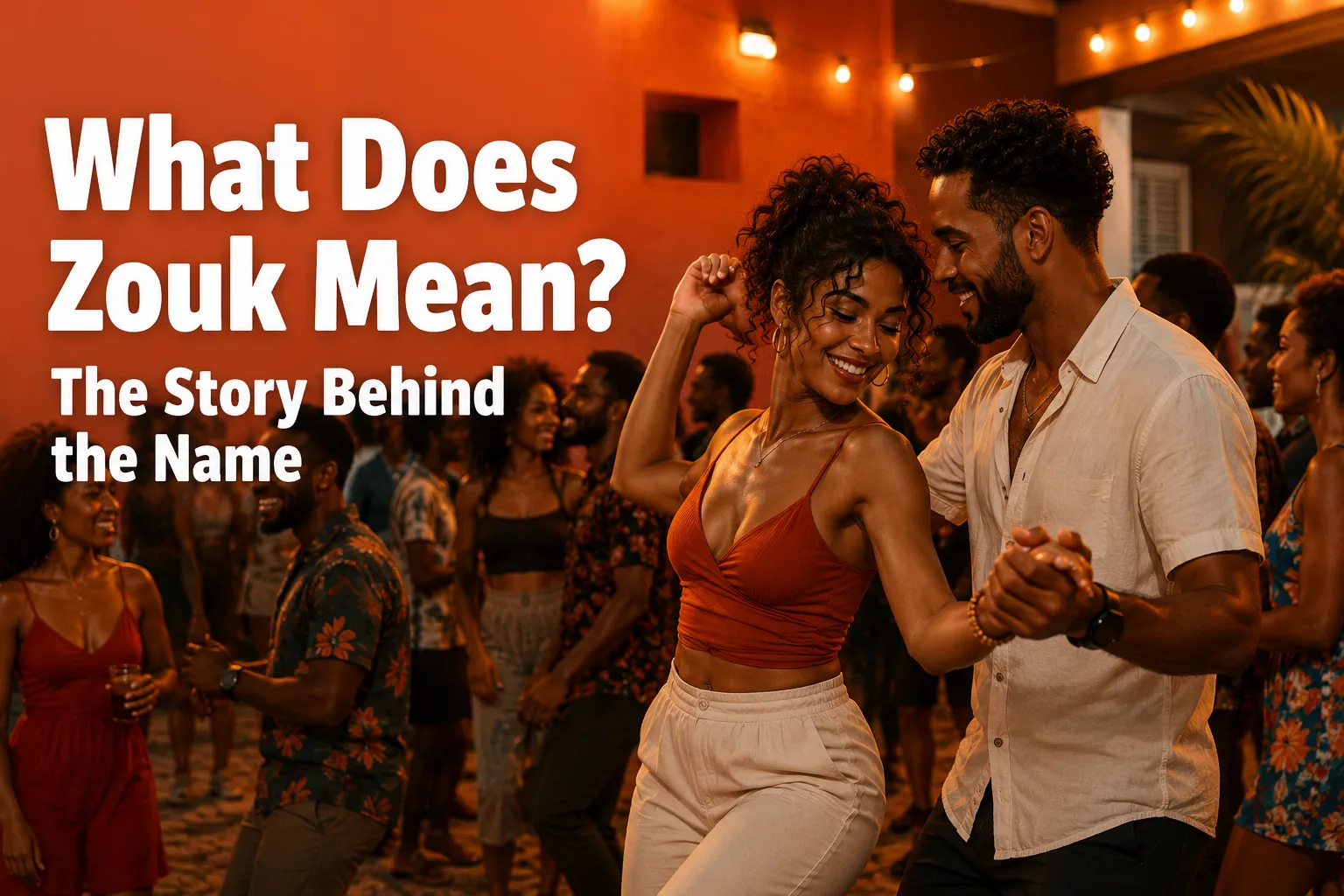
If you dance Brazilian Zouk, you probably use the word Zouk all the time.
You might hear people talk about Zouk classes, Zouk dancers or Zouk festivals. You might even hear dancers call themselves Zoukers.
But have you ever wondered what the word actually means?
The answer takes us far beyond Brazil.
Long before Brazilian Zouk existed, Zouk was already the name associated with a music and dance culture from the French Antilles, particularly Guadeloupe and Martinique.
So how did the same word become part of the name of a Brazilian partner dance?
And why does its use still generate debate today?
What does the word Zouk mean?
According to the SACEM Museum, Zouk was already used in Creole to describe a party held at someone's home before it became the name of the musical genre.
The same source traces the development of Zouk music to Kassav’, formed by musicians from Guadeloupe and Martinique. Beginning in the late 1970s, the group combined elements from different musical traditions, including Guadeloupean carnival rhythms, gwo ka, funk, salsa and other influences, to create the sound that became known as Zouk.
The official tourism website of Guadeloupe also describes Zouk as an emblematic music of Guadeloupe and Martinique, highlighting Kassav’ and musicians such as Jacob Desvarieux and Pierre-Édouard Décimus as central figures in its development.
But there is an important detail that sometimes gets lost when this history is told from a Brazilian Zouk perspective:
Zouk is not only music.
The official tourism website of Martinique describes Zouk as one of the best-known dances of the French West Indies and as an integral part of Antillean heritage.
In other words, long before the Brazilian dance adopted the name, Zouk already referred to a living musical and dance culture in the French Antilles.
Zouk existed before Brazilian Zouk
This distinction is important because three concepts that are sometimes confused actually have different histories.
Zouk music refers to the musical tradition that emerged in the French Antilles and became internationally associated with Kassav’. The SACEM Museum and the official tourism website of Guadeloupe both connect its development to Guadeloupe and Martinique.
Zouk dance refers to the dance associated with this Antillean musical and cultural tradition. Martinique's official tourism website explicitly identifies Zouk as a dance and describes it as part of French West Indian heritage.
Brazilian Zouk, meanwhile, is a Brazilian partner dance that evolved from Lambada. According to the Brazilian Zouk Dance Council (BZDC), dancers began using Caribbean Zouk music from the French Antilles as Lambada's popularity declined in the early 1990s, contributing to the transition that eventually became known as Brazilian Zouk.
Brazilian Zouk and Antillean Zouk dance are therefore not simply two versions of the same dance.
They developed in different cultural contexts and have different histories.
Understanding this distinction also helps explain why simply calling Brazilian Zouk “Zouk” can sometimes cause confusion.
So why is Brazilian Zouk called Zouk?
For that, we have to go back to Lambada.
According to the Brazilian Zouk Dance Council (BZDC), Brazilian Zouk evolved from Lambada during the early 1990s. As Lambada's popularity declined, dancers continued dancing and increasingly used Caribbean Zouk music from the French Antilles.
The BZDC explains that this combination initially gave rise to the informal term “French Lambada”, a reference to the French Creole lyrics of the songs. Over time, the dance became known simply as Zouk.
As the dance adapted to this musicality, its technique also evolved. According to the BZDC, Renata Peçanha and Adílio Porto played an important role in this transition in Rio de Janeiro, developing changes in technique, embrace and body language that contributed to the foundations of Brazilian Zouk.
But calling the dance simply Zouk created an obvious source of confusion: Zouk music and Zouk dance already existed in the Caribbean.
If you want to explore the complete story of this transition, read our article What Is Brazilian Zouk? History, Music & Origins.
Why does the name cause controversy?
For many Brazilian Zouk dancers, Zouk may simply feel like the familiar short name of their dance.
From an Antillean perspective, however, the word can carry a very different cultural meaning.
As the sources from Guadeloupe and Martinique show, Zouk existed before Brazilian Zouk and remains connected to Antillean music, dance and cultural heritage.
So when Zouk is used internationally as shorthand for Brazilian Zouk, some Antillean dancers and community members argue that the original Caribbean meaning of the word can become less visible.
This concern also appeared repeatedly in responses to a previous Duo post about the meaning of Zouk.
Some commenters from the French Caribbean emphasized that their concern was not simply that Brazilian dancers used Caribbean music, but that an existing cultural name became associated internationally with a different dance.
This is where we need to distinguish documented history from community perspective: the Antillean origins of Zouk are well documented; the interpretation of Brazilian Zouk's use of the name as cultural appropriation is part of an ongoing cultural debate.
Is Brazilian Zouk cultural appropriation?
There is no single answer accepted by everyone.
Some Antillean dancers and community members describe the use of the name Zouk by the Brazilian dance community as cultural appropriation, particularly when the Caribbean origins of the word, music and dance are not acknowledged.
That perspective appeared, for example, in responses from Antillean community members to Duo's own post about the origins of the word.
From this perspective, the issue isn't that cultures influenced one another. It is that a term connected to an existing Antillean cultural expression can sometimes be used without recognition of that culture.
Others understand the name Brazilian Zouk primarily through the documented historical development of the Brazilian dance: Lambada dancers began dancing to Caribbean Zouk music, the dance changed over time, and the word became attached to the emerging dance.
We explore this transition in more detail in What’s the Difference Between Lambada and Brazilian Zouk?
So rather than trying to give a definitive verdict on whether Brazilian Zouk is or isn't cultural appropriation, it may be more useful to understand why the question exists in the first place.
Cultural exchange or cultural appropriation: what's the difference?
Cultures have always influenced one another.
Music travels. Dance travels. People migrate, meet, exchange ideas and create new things.
Brazilian Zouk itself emerged through this kind of cultural contact: a Brazilian dance rooted in Lambada encountered music from the French Antilles, while teachers and dancers continued developing new techniques and approaches.
The BZDC documents this musical transition as an important part of Brazilian Zouk's development.
The debate about cultural appropriation begins when that exchange raises questions of recognition, context and visibility.
In this case, the question isn't whether Brazilian dancers were allowed to enjoy Zouk music.
It's whether using the word Zouk for a different dance can obscure the fact that Zouk was already the name of a living Antillean cultural expression.
That distinction helps explain why two people can look at the same history and interpret it differently.
Interestingly, Zouk isn't the only dance name connected to “party”
Here is where dance history gets even more interesting.
Several words we now associate primarily with music or dance originally had meanings connected to social gatherings.
As we saw earlier, the SACEM Museum explains that Zouk was used in Creole for a party held at someone's home before becoming the name of Kassav's musical creation.
Kizomba has a surprisingly similar linguistic connection. According to the Embassy of Angola, the word comes from Kimbundu, one of Angola's national languages, and means “party” or “celebration.”
The Embassy also describes French Antillean Zouk as one of the musical influences that contributed to Kizomba's development, alongside its Angolan roots in Semba.
Bachata has another interesting parallel. According to UNESCO, the term originally referred to a lively gathering or party, rather than specifically to a musical genre. UNESCO recognizes Dominican Bachata today as both music and dance and as part of the Dominican Republic's intangible cultural heritage.
These similarities don't mean Zouk, Kizomba and Bachata share the same origins.
But they remind us of something important: social dance, music and gathering have always been deeply connected.
Sometimes, even the names preserve that history.
Why does knowing this history matter?
You don't need to stop dancing Brazilian Zouk because you learned that the word came from somewhere else.
And recognizing the Antillean history of Zouk doesn't make Brazilian Zouk any less Brazilian.
It simply gives us a more complete understanding of the cultures that became part of its story.
For Brazilian Zouk dancers and teachers, that can start with something very simple: being precise with language.
Zouk music, Antillean Zouk dance and Brazilian Zouk are not interchangeable terms.
Learning about the music and dance cultures of Guadeloupe and Martinique, acknowledging them when explaining the history of Brazilian Zouk, and using the full name Brazilian Zouk when context requires it can help preserve those distinctions.
Because knowing where a word comes from doesn't take anything away from the dance we love.
It adds another layer to its history.
Explore dance communities around the world with Duo
Dance cultures are constantly crossing borders, connecting people and creating new communities, and Brazilian Zouk is only one part of that story.
With Duo, you can discover classes, socials, workshops and festivals around the world, from Brazilian Zouk and Lambada to Kizomba, Bachata, Salsa, West Coast Swing, Forró, Tango, Samba de Gafieira and more.
Whether you're looking for your next social, planning a dance trip or curious to explore a new style, Duo helps you find where and what people are dancing around the world.
Download Duo and discover your next dance.


Frequently asked questions
What does “Zouk” mean?
The word Zouk is associated with the idea of a party or social gathering in French Caribbean Creole. Before becoming internationally associated with a musical genre, the term was already used in this context in the French Antilles.
Where does Zouk come from?
Zouk music and dance are rooted in the French Antilles, particularly Guadeloupe and Martinique. The musical genre became internationally known in the 1980s, with Kassav’ playing a central role in its development and popularity.
Are Zouk and Brazilian Zouk the same dance?
No. Antillean Zouk dance and Brazilian Zouk have different histories and cultural contexts. Brazilian Zouk developed in Brazil from Lambada and became associated with the name Zouk after dancers began using Caribbean Zouk music.
Why is Brazilian Zouk called Zouk?
As Lambada dancers in Brazil began dancing to Zouk music from the French Antilles, the name of the music gradually became associated with the evolving Brazilian dance. Over time, Brazilian Zouk became the name used to distinguish it from Caribbean Zouk.