Why Does Everyone Seem to Dance Better on Social Media?
Written by Larissa Ferreira
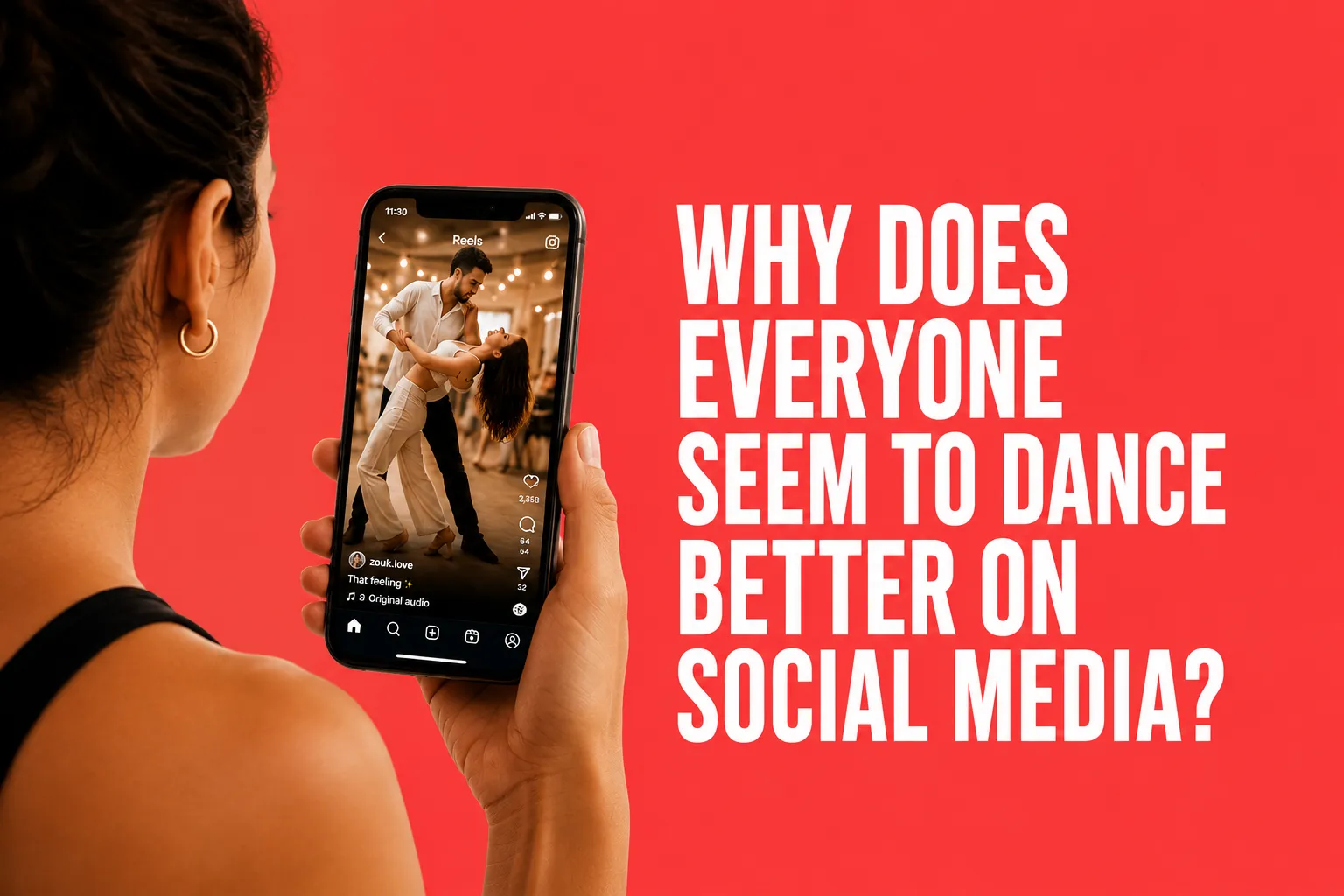
You open Instagram and see a couple dancing with flawless head movements. Then comes a perfect cambré. Next, a sequence that looks almost impossible to pull off.
Then you go to your local social and catch yourself thinking: "Am I learning too slowly?"
If you've ever felt that way, you're definitely not alone.
And the short answer is: probably not.
Social media only shows one side of Brazilian Zouk, usually the most visually impressive, exciting, and shareable moments.
That doesn't mean it reflects the full experience of being a dancer.
Instagram shows moments, not the journey
It's hard to imagine someone posting a video where the dance didn't go as planned.
Most of what ends up on Instagram is exactly the opposite: the song that felt just right, a partner with amazing connection, a special event, or simply a dance worth remembering.
That's true for almost everyone, and it makes sense. Social media is meant for sharing the moments we're happiest with.
The problem is that when we spend a lot of time consuming this kind of content, it's easy to forget that it represents only a small part of reality.
After watching dozens of amazing videos in just a few minutes, you can easily start believing that's what the entire community looks like.
In reality, anyone who regularly attends classes and socials knows it's much more diverse than that. Dancers come from different backgrounds, have different styles, and are all at different points in their journey.
A 30-second video can take hours to make
If you've never recorded a dance video, it's easy to assume everything happened exactly as it appears on screen.
But there's often much more behind a single reel.
Maybe it was the third take. Or the tenth.
Sometimes a couple decides to record again because the music felt better the second time. Other times someone walked in front of the camera, or a movement didn't come out the way they had imagined.
None of this takes away from the quality of the video.
If anything, it simply reminds us that we're looking at the final result, not everything that happened before it.
The algorithm chooses what you see
Social media platforms naturally promote content that grabs people's attention quickly. In Brazilian Zouk, that often means big movements, dramatic head movements, cambrés, and moments that make people stop scrolling.
There's nothing wrong with that. Those videos are beautiful to watch and often inspire others to discover the dance.
But there's also a side effect: it's easy to start believing that's what social dancing looks like all the time.
Anyone who regularly attends a social knows that's not really the case. Some of the best dances of the night would probably never go viral.
Sometimes what makes a dance unforgettable isn't a spectacular move. It's the connection between two people, the musicality, or the way they interpret the music together.
And maybe that's one of the most beautiful things about Brazilian Zouk: the best dance isn't always the one that would make the best Reel.
What does real progress look like?
When we first start dancing, it's natural to measure our progress by the movements we've learned. After all, those are the moments that stand out most in videos.
But over time, many dancers realize that improvement goes far beyond that.
Maybe you can now improvise through an entire song without thinking about your next step. Maybe you feel more confident asking someone to dance at a Social.
Or perhaps you've become better at adapting to different partners, listening to the music, or simply enjoying each dance a little more.
These kinds of improvements don't always show up in a video, and they're unlikely to go viral. Still, they're often the changes that matter most in the long run.
Is it normal to compare yourself?
It's hard to find someone who hasn't done it. Almost every dancer has compared themselves to someone else at some point.
You watch an incredible video and think back to your last dance.
"I'll never be able to do that."
That comparison happens almost automatically. The problem is that it's rarely fair.
You're comparing months, or even years, of your own experience to a few carefully selected seconds of someone else's.
Nobody posts every attempt. Or the class where nothing seemed to work. Or the song where the connection just wasn't there.
So the next time you catch yourself comparing, try to remember that you're only seeing a small part of someone else's story.
So, should you stop watching dance videos?
Of course not.
Videos inspire us. They introduce us to new artists, showcase amazing events, and often make us want to try a new movement.
Just remember that no video tells the whole story.
The real growth happens during classes, through mistakes, at socials, in conversations after a dance, and in the people you meet along the way.
Recently, we shared a quote on social media that perfectly captures this idea:
"Dance doesn't ask you to be perfect. It asks you to be present."
At the end of the day, being present matters far more than looking perfect for 30 seconds.
Ready to turn inspiration into experience?
Watching videos can spark your curiosity, but the real magic happens on the dance floor.
Whether you're looking for classes, communities, socials, or Brazilian Zouk festivals, Duo helps you discover events close to home or wherever your next trip takes you.
Download Duo and find your next dance.