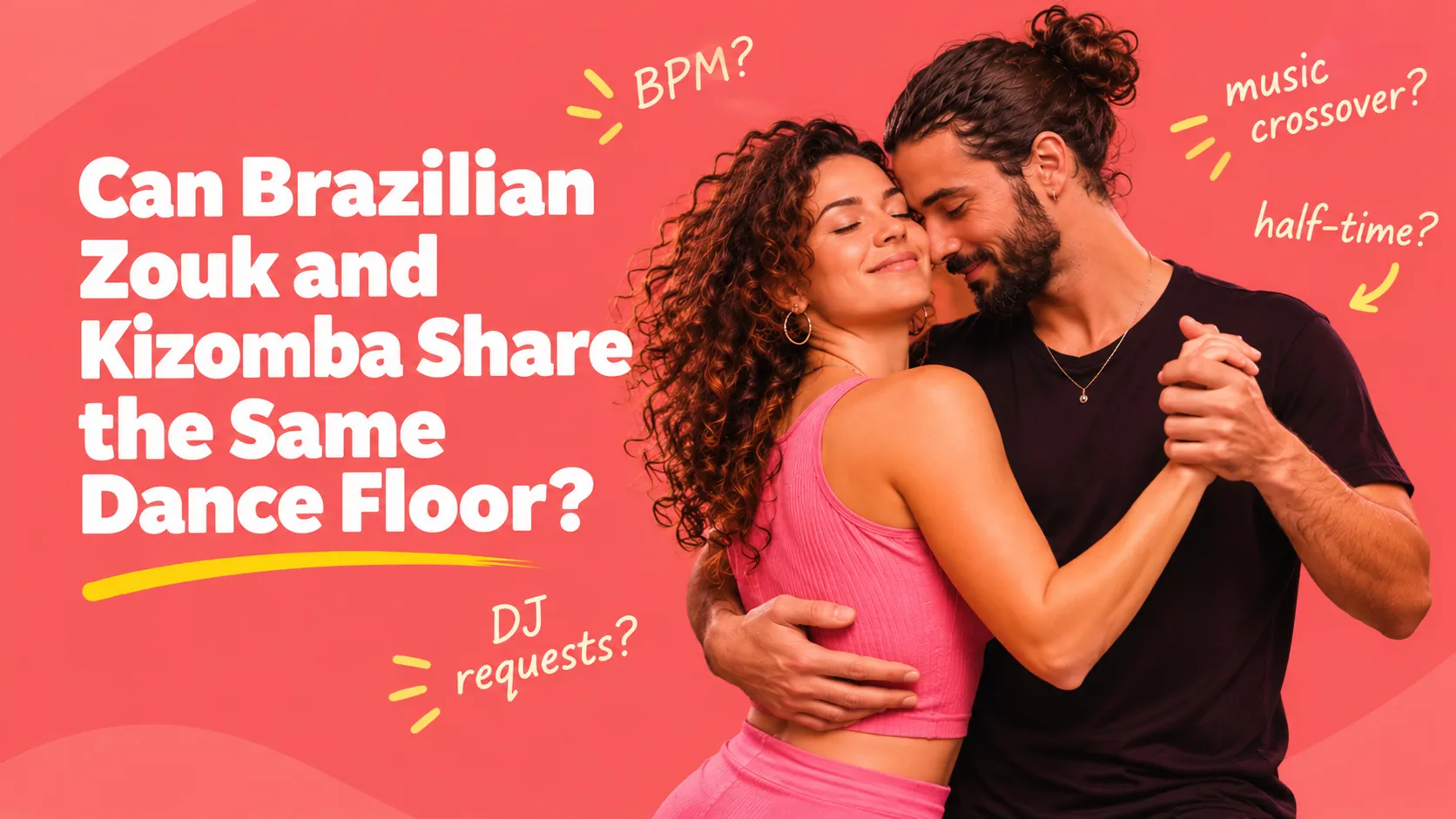
Can Brazilian Zouk and Kizomba Share the Same Dance Floor?
Written by Larissa Ferreira
Imagine living in a city where the Brazilian Zouk community is still growing.
There aren't enough dancers for a dedicated social every weekend, so you and your friends regularly attend a Salsa and Bachata party that also plays some Kizomba music.
Every time a Kizomba track comes on, you think: finally, something we might be able to dance Brazilian Zouk to!
But the music feels too fast.
You could ask the DJ to play something different. But what about the Kizomba dancers who came specifically to enjoy that music?
This was the dilemma raised by a dancer in the ZoukNerds community.
And it brings up a bigger question: can two dance communities find common musical ground without one having to give up space for the other?
Different dances, connected musical histories
Brazilian Zouk and Kizomba are distinct dances with their own histories, techniques and cultural identities.
But there is an interesting connection between their musical histories: Caribbean Zouk.
According to the Brazilian Zouk Dance Council, Brazilian Zouk developed from Lambada in Brazil as dancers adapted their movements to Caribbean Zouk music.
In Angola, Kizomba music developed under the influence of traditional Semba and Caribbean Zouk, as explained by Angolan dance educator José N'dongala in his Kizombalove Teaching Syllabus.
N'dongala makes an important distinction between the musical influences on Kizomba and the development of the dance itself, which has roots in Angolan dance traditions.
These musical connections don't make Brazilian Zouk and Kizomba interchangeable. But they help explain why exploring shared musical ground is an interesting possibility.
Is there an ideal BPM for both dances?
Several dancers in the ZoukNerds discussion suggested exploring tracks around 80–85 BPM, while others mentioned slower tempos or music around 90 BPM and below.
These suggestions reflect individual experiences rather than an established tempo range for both dances.
According to DJ Zen Eyer's guide to Brazilian Zouk BPM, Brazilian Zouk can be danced across a broad tempo range, with many tracks working particularly well between 70 and 85 BPM.
That doesn't mean every Kizomba dancer will enjoy music within that range.
And it doesn't mean every song at 85 BPM will work for Brazilian Zouk.
As we explored in What Music Can You Dance Brazilian Zouk To?, tempo is only part of the picture.
The rhythm, phrasing, musical accents and overall structure of a song also influence how dancers experience it.
Finding a shared BPM is a starting point, not a complete solution.
Finding common ground through music
One interesting aspect of the ZoukNerds discussion was how quickly dancers moved beyond BPM and started suggesting specific musical styles and artists.
Among the suggestions were:
- Zouk Love
- Cabo Love
- Douceur
- Artists such as Mika Mendes and Nelson Freitas
But there's an important distinction to make here.
Not all music played at Kizomba events belongs to the traditional Angolan Kizomba genre.
Pacific Northwest Kizomba explains that the musical repertoire associated with Urban Kiz can also include Ghetto Zouk, R&B remixes, Afropop and electronic music such as Douceur.
These musical styles may offer interesting possibilities for crossover, but their suitability for both dances depends on the individual track and the dancers' preferences.
Instead of asking a DJ to play something broadly described as music for Brazilian Zouk, it might be more useful to suggest specific tracks and explore whether they work for both communities.
The idea isn't to create the perfect crossover playlist.
It's to start discovering where musical preferences overlap.
What if we adapted our dancing instead?
Another suggestion from the ZoukNerds community was to explore dancing in half-time.
The musical idea behind this approach is that a listener can perceive a slower pulse without the actual tempo of the song changing. This relationship between perceived tempo and musical structure is explored in a study published in Music Theory Online.
Applied to dancing, some participants suggested interpreting faster music through a slower pulse.
For them, this can make certain tracks more comfortable to dance to. However, it isn't necessarily a solution for every song or every dancer.
Another participant suggested learning some Kizomba fundamentals.
That raises an interesting possibility.
Perhaps finding common ground doesn't always mean asking the DJ to adapt the music to your dance. Sometimes it means exploring how your dancing can adapt to the music.
And learning a little about another dance style can also help you understand what the people sharing the floor with you are listening for.
How do you ask a DJ to play music for both communities?
Imagine being the DJ at this social.
You're already balancing different musical preferences, watching the dance floor and trying to keep people engaged.
Then a group of dancers asks you to change the music.
How they approach that conversation can make a difference.
Rather than saying:
“The Kizomba music is too fast for us. Can you play more Brazilian Zouk?”
You could try something like:
“There's a small group of Brazilian Zouk dancers who regularly attend your social. We really enjoy coming here and were wondering if you'd be open to playing a few tracks that both Kizomba and Brazilian Zouk dancers might enjoy. We'd be happy to share some examples.”
You're not asking the DJ to stop playing music for another community.
You're inviting them to explore something that might work for both.
Several participants in the ZoukNerds discussion also offered practical suggestions:
- Share a few specific tracks instead of making a vague request.
- Let the DJ decide when those tracks fit into the set.
- Be ready to dance when the requested music comes on.
- Thank the DJ afterward.
That last part matters more than it might seem.
If you ask for music and then remain seated when it plays, the DJ has little reason to believe that your request worked for the dance floor.
You could also contact the organiser before the event. This gives them and the DJ time to consider your suggestions without having to make an immediate decision during the social.
Sharing music also means sharing space
Finding a song that works for two dance styles doesn't automatically mean those styles will move comfortably around each other.
Brazilian Zouk and Kizomba can use space differently.
Depending on the movement, Brazilian Zouk may involve rotations, travelling patterns or head movements that require additional awareness of the surrounding dancers.
At a crowded mixed social, you might need to reduce the size of your movements or leave certain patterns for another environment.
The point isn't that one dance deserves more space than another.
Everyone deserves to feel comfortable and safe on the dance floor.
Musical compatibility is only one part of making a shared social work.
Maybe not every song needs to work for everyone
A mixed social doesn't necessarily need a playlist where every track pleases every dancer.
Sometimes the Kizomba dancers will have their moment.
Sometimes the Brazilian Zouk dancers will have theirs.
And sometimes a song will bring both communities onto the floor at the same time.
Maybe that's enough.
For a growing dance community, finding a place to dance regularly can be an important step towards building something bigger.
But becoming part of an existing social also means recognising the community that was already there.
The goal isn't necessarily to make every song suitable for Brazilian Zouk.
It's to find a way for more people to belong on the same dance floor, without asking anyone to give up what brought them there in the first place.
Find your next dance floor with Duo
Whether you're looking for a dedicated Brazilian Zouk social, a Kizomba festival or an event where different dance communities come together, Duo helps you discover dance events around the world.
Explore classes, socials, workshops and festivals across Brazilian Zouk, Kizomba, Salsa, Bachata, Lambada, West Coast Swing, Forró and more.
Download Duo and discover your next dance.


Frequently asked questions
Can you dance Brazilian Zouk to Kizomba music?
Yes, some music played at Kizomba socials can also work for Brazilian Zouk. Suitability depends on the track's tempo, rhythm, phrasing, structure and how dancers interpret it.
What BPM works for both Brazilian Zouk and Kizomba?
There is no universally ideal BPM for both dances. Some dancers suggest exploring tracks around 80–85 BPM, but musical structure and individual preferences also matter.
What music can Brazilian Zouk and Kizomba dancers share?
Dancers have suggested exploring Zouk Love, Cabo Love, Douceur and certain crossover tracks. Whether a song works for both dances depends on its musical characteristics and the dancers' preferences.
Can you dance Brazilian Zouk in half-time to faster music?
Some Brazilian Zouk dancers suggest interpreting faster music through a slower pulse. This approach may make certain tracks more comfortable to dance to, but it requires musical awareness and may not work equally well with every song.
How should I request Brazilian Zouk music at a mixed social?
Approach the DJ or organiser respectfully, suggest specific tracks that might appeal to both dance communities and allow the DJ to decide when they fit into the set.